De-Icing Salt Damage to Concrete in the Pikes Peak Region: Magnesium Chloride vs. Calcium Chloride
Every winter, driveways, walks, and steps across the Pikes Peak region get treated with some form of de-icing salt to keep them safe to walk and drive on. That's a reasonable trade — nobody wants an icy driveway on a steep grade — but it's also a trade with a real cost to the concrete underneath, and the cost varies a lot depending on which product gets used and how much of it goes down over a season.
Two Common De-Icers, Two Very Different Effects on Concrete
The two most common de-icing chemicals used on driveways and walks in this region are magnesium chloride (MgCl₂) and calcium chloride (CaCl₂). Both work the same basic way — they lower the freezing point of water so ice melts at temperatures where plain water would stay frozen — but they are not equivalent when it comes to what they do to concrete over time.
Controlled scaling tests comparing the two are telling. A 4% magnesium chloride solution has produced a moderate scaling rating around 3.1 in durability testing, compared to roughly 1.6 for an equivalent calcium chloride solution — meaning magnesium chloride causes close to double the surface scaling damage of calcium chloride at a similar concentration. Beyond surface scaling, magnesium chloride is also documented as considerably more corrosive to embedded steel: it can be up to 10 times more corrosive to mild steel rebar than calcium chloride. For any driveway, patio, or walkway with rebar or wire mesh reinforcement close to the surface, that corrosion difference matters enormously over the life of the slab.
Calcium chloride isn't harmless, but it's the meaningfully less damaging of the two common options. If you have a choice in what gets applied to your own concrete — as opposed to a municipal or HOA-managed area — that difference is worth knowing before you buy a bag off the shelf.
The Mechanism: Why Salt Damage Gets Worse, Not Better, Over Time
De-icing salt doesn't just sit on the surface and melt ice. Once it's in contact with concrete, it does two things that compound each other over a winter and over the years:
- It increases pore water content. Chloride-based de-icers change how much water the concrete's pore structure holds and how readily it stays liquid at lower temperatures. That extra water is exactly what's available to freeze and expand inside the slab during the next freeze-thaw cycle, which intensifies the freeze-thaw damage described in our elevation guide — the salt isn't a separate problem from freeze-thaw, it's making freeze-thaw worse.
- It eventually reaches embedded rebar and starts corrosion. Concrete naturally protects steel reinforcement with a thin, stable oxide layer, but chloride ions that penetrate deep enough break that layer down. Once corrosion starts, it's a self-worsening problem: rusting steel physically expands, and that expansion cracks and pushes apart the concrete around it from the inside. This is exactly how a slab goes from surface-level scaling to a full spall — a chunk of concrete blown off the surface — over a few seasons.
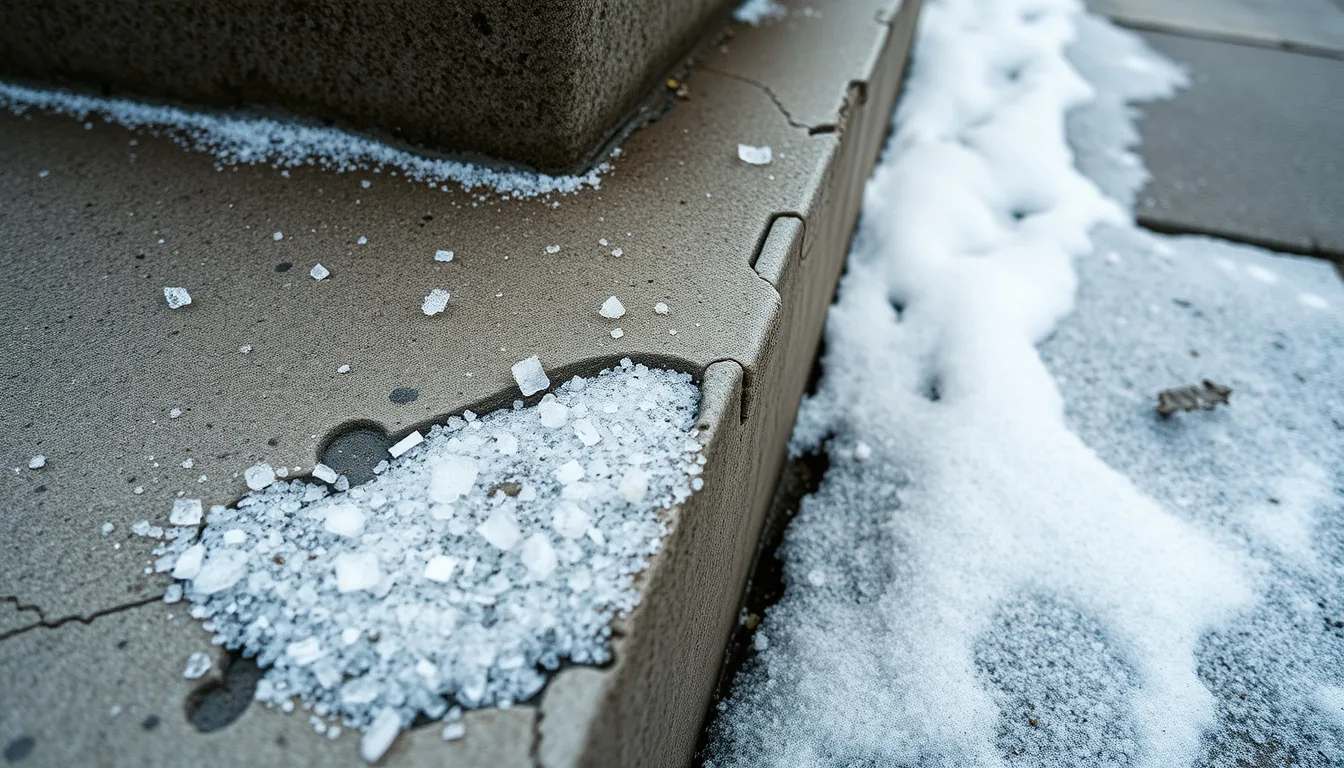
Left alone, salt damage follows a predictable progression: light surface scaling and pitting first, then flaking and popped aggregate as it gets worse, then spalling once corrosion of embedded steel joins in. Repair cost roughly tracks that same progression, which is exactly why catching scaling early is one of the cheapest fixes available and letting it run for several winters turns it into one of the most expensive.
Why Elevation and Grade Mean More Salt, Not Less
Here's the part of the story that's specific to the Pikes Peak region rather than the Front Range generally: driveways and roads at higher elevation and on steeper grades tend to get de-iced more heavily per season than flat Denver-metro flatwork, for a few compounding reasons.
- Steeper grades ice over first and pose a bigger hazard. A flat driveway that gets a skim of ice is an inconvenience. A driveway that climbs a full story from street to garage, common in Manitou Springs, Woodland Park, and Cascade, becomes genuinely unsafe to walk or drive on with even a thin layer of ice — which means homeowners and property managers reasonably apply product more aggressively and more often on steep sections specifically.
- Higher-elevation towns see more frequent winter weather events. Towns like Woodland Park, Divide, and Cripple Creek sit high enough that they experience more frequent snow, freezing drizzle, and melt-refreeze cycling over a season than lower-elevation towns like Fountain, simply because they're colder more often and exposed to more winter weather systems moving through the corridor. More weather events call for more applications.
- Intense high-altitude sun creates melt-refreeze cycles that call for repeat treatment. As covered in our elevation guide, strong high-altitude sun can melt surface snow and ice even when air temperature stays below freezing, and that meltwater often refreezes as black ice once the sun goes down. That cycle can call for a second or third de-icing application in a single day on a driveway that would have needed just one application at a lower elevation.
- Mountain-corridor roads set expectations that carry over to private driveways. Highway 24 and other mountain-corridor routes see heavy municipal and CDOT de-icing product use to keep steep mountain roads passable through the winter, and that heavier-use pattern often carries over to how aggressively homeowners and HOAs treat adjacent private driveways and walks.
The net effect: it's reasonable to expect that a steep, high-elevation Pikes Peak region driveway sees more total de-icing product applied over a winter than a comparable flat driveway in Denver or Colorado Springs proper — not because anyone is doing anything wrong, but because the terrain and the weather genuinely call for it. That heavier use is exactly why concrete in this region benefits more from proactive protection than concrete in flatter, lower-elevation markets.
Protecting Your Concrete Without Giving Up Winter Safety
You don't have to choose between a safe driveway and a driveway that isn't slowly being eaten away by salt. A few practical steps make a real difference:
- Favor calcium chloride over magnesium chloride where you control the choice. On your own driveway, walk, or patio, calcium chloride does meaningfully less scaling and corrosion damage for a similar de-icing effect.
- Use sand or a similar abrasive for traction where ice isn't severe. Sand doesn't melt ice, but it restores traction without adding any chloride load to the concrete at all, and it's a reasonable substitute on moderate slopes in light conditions.
- Apply a quality penetrating sealer before winter. A sealer that keeps chlorides from soaking into the pore structure in the first place is one of the highest-value, lowest-cost things you can do for concrete that's going to see heavy de-icing exposure every year.
- Rinse residual salt off when a thaw allows it. Letting de-icing product sit on the surface through repeated melt-refreeze cycles gives it more time to penetrate; a rinse during a warm spell reduces that exposure.
- Catch scaling early. A driveway that's just starting to show light surface pitting or scaling is a far cheaper fix than one that's progressed to spalling with exposed, corroding rebar.
Frequently Asked Questions
Which is worse for concrete, magnesium chloride or calcium chloride?
Magnesium chloride is meaningfully more damaging. In controlled scaling tests it produced roughly double the scaling rating of an equivalent calcium chloride solution, and it's documented as up to 10 times more corrosive to mild steel rebar. Calcium chloride still has some effect on concrete but is the clearly less damaging of the two common de-icing chemicals.
Why does de-icing salt cause cracking, not just surface staining?
Because chloride de-icers do two things at once: they increase how much water the concrete's pore structure holds, which intensifies freeze-thaw expansion inside the slab, and they eventually penetrate deep enough to corrode embedded rebar. Corroding steel physically expands, which cracks and pushes apart the surrounding concrete from the inside — that's how surface scaling progresses into structural spalling over time.
Do driveways at higher elevation in this region really get more salt than driveways in Denver?
It's reasonable to expect so, for a few converging reasons: steeper grades ice over first and get treated more aggressively for safety, higher-elevation towns see more frequent winter weather events, and intense high-altitude sun can create melt-refreeze cycles that call for repeat applications in a single day. None of that is a precisely measured statistic for any specific address, but the combination of steeper terrain and more frequent winter weather at elevation reasonably points toward heavier seasonal de-icing use than flat, lower-elevation driveways see.
Is sand a good alternative to salt for icy driveways?
Sand is a solid option where you need traction rather than melting — it doesn't add any chloride load to the concrete at all. It won't melt existing ice the way a chloride product will, so many properties use a combination: chloride product when melting is genuinely needed, sand for traction the rest of the time.
Can salt damage be repaired, or does it mean the driveway needs to be replaced?
In most cases it can be repaired rather than replaced. Early scaling is often addressed with a straightforward surface patch. More advanced damage with exposed, corroding rebar needs the steel cleaned or replaced as part of the repair. Only the most severe, widespread spalling typically calls for full demolition and recast — most salt-damaged concrete in this region is a repair job, not a replacement job, especially when it's caught before corrosion sets in.
How often should I seal my driveway if it gets de-iced every winter?
A quality penetrating sealer generally needs reapplication every 2 to 3 years, and driveways in this region that see heavy de-icing product use — steep grades, higher-elevation towns — benefit from staying on the shorter end of that window rather than stretching it out.
Protect Your Concrete Before Next Winter
If your driveway, walk, or patio is already showing scaling, pitting, or the early signs of spalling, that damage isn't going to reverse itself, and it tends to get more expensive the longer it's left alone. We inspect and repair de-icing salt damage across the full Pikes Peak region — Colorado Springs, Manitou Springs, Woodland Park, Cascade, Green Mountain Falls, Fountain, Monument, Palmer Lake, Divide, and Cripple Creek. Request a free inspection through our online form, and let's get ahead of the damage before the next round of winter weather adds to it.
Ready for a real number?
Free inspections across the Pikes Peak region — measured on site, fixed price before any drilling starts.