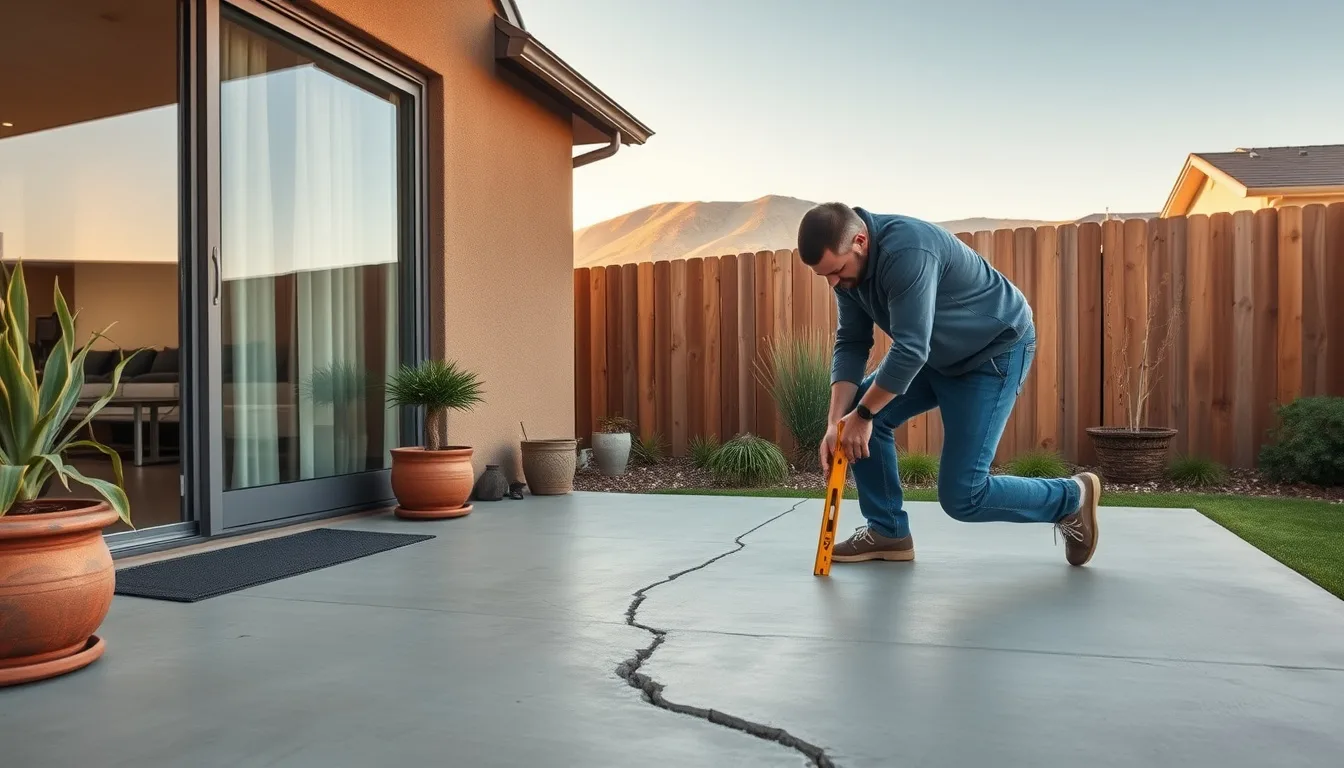
Patio Repair — Pikes Peak Region
Patio Repair in the Pikes Peak Region — Fixing Cracks, Settlement, and Surface Damage on Sloped Ground
Your patio takes the brunt of both worlds — full sun exposure and mountain-corridor terrain. We diagnose whether grade, freeze-thaw, or soil movement is driving the damage before we touch it.
Patios Take More Weather Exposure Than Almost Any Other Slab
A patio sits fully open to sun, snow, and rain with none of the thermal buffering a garage floor or covered walkway gets — which makes it one of the hardest-working surfaces on a property in a mountain climate. It's also usually the surface homeowners notice damage on first, since it's where you're standing barefoot, setting up furniture, or watching a crack widen season over season right outside the back door.
Across Colorado Springs, Manitou Springs, Woodland Park, and the surrounding towns, patio damage usually comes down to one of three drivers working alone or together: freeze-thaw cycling intensified by elevation, drainage problems specific to sloped lots, or expansive clay soil movement underneath a slab that was never built to resist it. We diagnose which one (or which combination) is at play before recommending a fix, because a crack caused by soil heave and a crack caused by trapped meltwater get repaired differently.
Elevation Freeze-Thaw on an Uncovered Slab
The Denver-metro baseline for freeze-thaw cycling runs around 149 crossings a year. Pikes Peak region elevations — Colorado Springs around 6,035 feet, Manitou Springs and Green Mountain Falls near 6,300 to 7,800 feet, Woodland Park and Divide around 8,400 to 8,900 feet, Cripple Creek near 9,500 feet — see more crossings than that baseline in a typical winter, not fewer. Thinner air at altitude changes temperature faster between day and night, and strong high-altitude sun thaws snow sitting on a patio slab even when the air around it stays below freezing.
An uncovered patio absorbs that cycling directly, with no roof or overhang to shield it the way a covered porch would. Every melt-refreeze crossing works on any existing hairline crack or open control joint, since water trapped inside expands roughly 9% in volume as it freezes — a small crack that seemed stable in October is often visibly wider by March if it was never sealed.
Hillside Lots Change Where Water Goes — and Where a Patio Fails
Pikes Peak region patios are frequently built on real grade rather than flat ground, especially in the foothills and mountain-corridor neighborhoods around Manitou Springs, Cascade, and Woodland Park. On a sloped patio, water doesn't distribute evenly the way it does on flat Front Range flatwork — it sheets off the steep sections and concentrates at low points, seams, or wherever a single drainage channel was cut into the grade. That means cracking, scaling, and joint separation tend to cluster at predictable low spots rather than spreading across the whole slab.
A lot of patios in this region also sit directly against a walkout foundation on a hillside lot. When the grading around that patio is working correctly, water sheds away from the house; when it isn't — because the slab has settled, tilted, or a joint has opened — runoff gets redirected toward the foundation instead. That's a bigger problem than a cracked patio alone, which is why any patio repair on a walkout-adjacent slab includes checking that the surrounding grade is still moving water in the right direction, not just fixing the concrete in isolation.
Why Freeze-Thaw Damage Often Looks Patchy on a Graded Patio
One pattern we see constantly on sloped patios: damage isn't uniform. Flatter mid-sections and low corners hold overnight meltwater that refreezes and expands right there, while steeper runs shed water fast enough to largely avoid that exposure. The result is a patio that looks fine across most of its surface but has real scaling, pitting, or cracking concentrated in one or two spots — usually the flattest, lowest-lying section.
That patchy pattern is actually useful diagnostically. If damage on your patio is clustered rather than spread evenly, grade and standing water are very likely part of the cause, and a repair that only addresses the visible crack without correcting the water path underneath it is likely to need redoing within a few winters.
Repair Methods: Resurfacing, Injection, and Spalling Repair
For surface-level damage — light scaling, hairline cracking, a dated or discolored finish — resurfacing or a decorative overlay restores the surface without a full tear-out. Basic resurfacing runs $3 to $5 per square foot; more extensive surface prep to handle deeper scaling or pitting can run up to $9 per square foot; stamped or decorative overlays that upgrade the look of the patio entirely run $7 to $20 per square foot.
For cracks, we match the material to how the crack behaves: caulk sealant for hairline cracks under 1/8 inch, chiseled filler for mid-width cracks, and epoxy or flexible polyurethane injection for structural cracks — flexible injection specifically for cracks still moving with seasonal clay swelling, epoxy for cracks that have stabilized. Where salts, moisture, and freeze-thaw have caused deeper surface flaking or exposed rebar, spalling repair runs $20 to $50 per square foot for a minor patch up to $150 per square foot where rebar work is involved.
Lifting and Leveling a Settled Patio Slab
When a patio section has sunk or tilted — often from soil consolidation or clay movement underneath — we lift it back into place rather than replacing it outright. Mudjacking pumps a cement-based slurry under the slab, runs $3 to $6 per square foot, cures in 1 to 3 days, and typically needs to be redone in 5 to 10 years. Polyurethane foam injection is lighter, runs $5 to $25 per square foot, and cures in about 15 minutes, which matters if furniture needs to go right back on the patio the same day.
The goal on a graded patio is never a perfectly flat surface — it's restoring the slope the patio was built with, so water keeps draining away from the house rather than pooling where the walkout foundation meets the concrete. Flattening a sloped patio without preserving that intended grade can quietly create a new drainage problem right where the old one was fixed.
What Patio Repair Costs, in Full
Most patio repair jobs regionally land in one of three buckets: crack injection and sealing ($5–$25-plus per linear foot depending on width and material), resurfacing or decorative overlay ($3–$20 per square foot depending on scope), or lifting and leveling a settled section ($3–$25 per square foot depending on method). Spalling repair with rebar exposure runs higher, $50–$150 per square foot, and a full demo-and-recast for a badly failed section runs $150–$400-plus per square foot.
We give a fixed price after seeing the patio in person, since the same visible crack can mean very different scope depending on whether it's driven by surface freeze-thaw, soil movement underneath, or a drainage problem feeding water to the same spot every storm.
Get a Free Patio Inspection
Send us photos of the cracking, settling, or flaking and your city, or book a free on-site inspection anywhere across the region. We check the crack pattern, the slope, and how water is moving around the slab before recommending anything — then give you a fixed price before work starts.
Request a free estimate through our online form. We repair patios throughout Colorado Springs, Manitou Springs, Woodland Park, Cascade, Green Mountain Falls, Fountain, Monument, Palmer Lake, Divide, and Cripple Creek.
Patio Repair FAQs
Straight answers before we drill
On sloped or graded patios, water sheets off steep sections but concentrates at low points and flatter areas, where it can sit overnight and refreeze. That uneven exposure is why freeze-thaw and scaling damage on a hillside-lot patio often clusters in one section rather than spreading evenly across the whole slab.
Yes. If a patio against a walkout foundation has settled or a joint has opened, runoff can get redirected toward the house instead of away from it. Repair on a walkout-adjacent patio should include checking that the surrounding grade still sheds water correctly, not just patching the visible concrete damage.
Both lift a settled slab back to grade. Mudjacking is more cost-effective at $3–$6 per square foot but needs 1–3 days to cure and typically lasts 5–10 years. Polyurethane foam costs more per square foot but cures in about 15 minutes, which matters if the patio needs to be usable again the same day.
Resurfacing runs $3–$5 per square foot for basic work, up to $9 per square foot for patios needing extensive surface prep, and $7–$20 per square foot for stamped or decorative overlays. Full demo-and-recast for badly failed concrete runs $150–$400-plus per square foot, so resurfacing is almost always the more cost-effective route when the underlying slab is still structurally sound.
Yes. Uncovered patios take the full brunt of freeze-thaw cycling with no roof or overhang for protection, and at Pikes Peak region elevations, thin air and intense high-altitude sun drive more frequent melt-refreeze crossings in a winter than the Denver-metro baseline of roughly 149 cycles a year — each crossing widens existing cracks a little more.
Cracked, sunken, or salt-damaged concrete? Get a fixed price before we drill.
Free inspections across the Pikes Peak region. We diagnose high-elevation freeze-thaw, steep-grade drainage, and expansive-soil causes before recommending a repair.