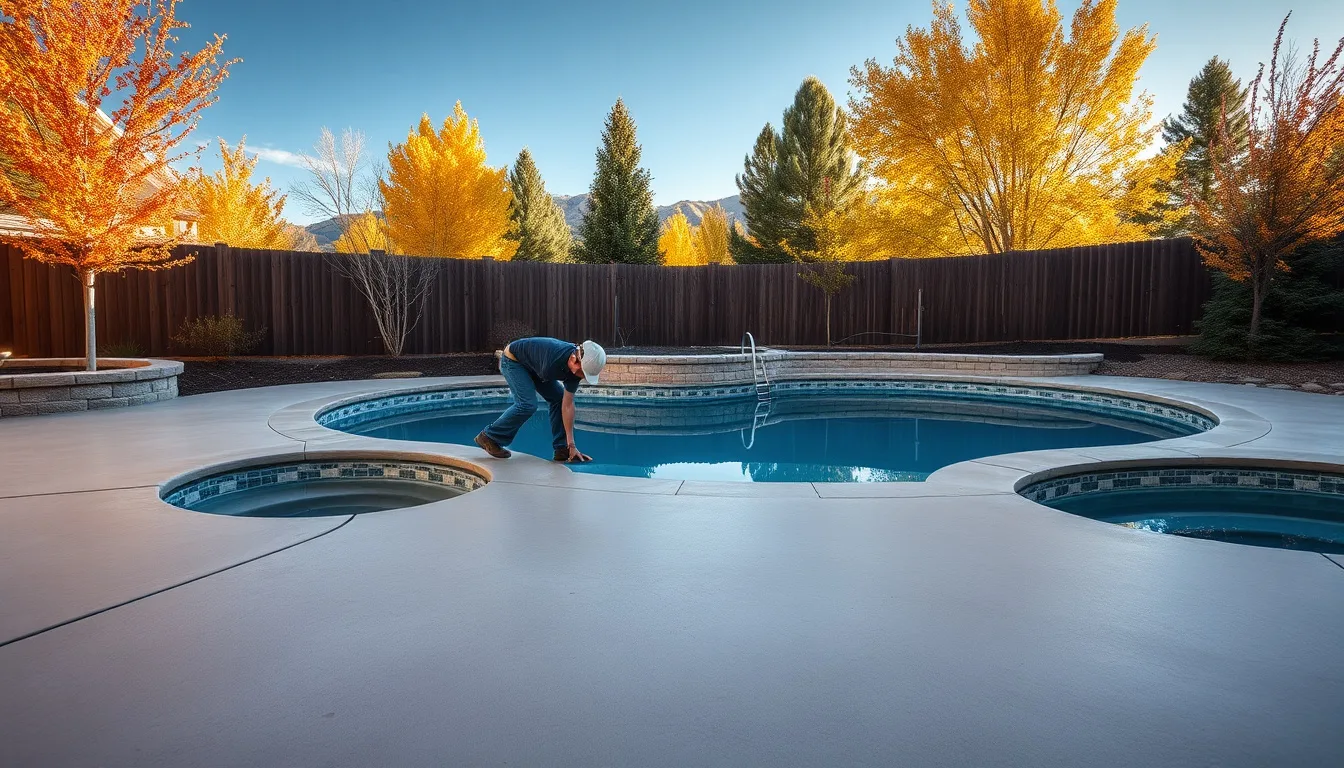
Pool Deck Repair — Pikes Peak Region
Pool Deck Repair in the Pikes Peak Region — Fixing Settlement, Cracking, and Surface Wear Around the Water
A pool deck sits on backfilled ground with unpredictable voids underneath, and it takes more moisture exposure than almost any other slab on the property. We repair it accordingly.
Why Pool Decks Settle Differently Than Any Other Slab
When a pool is installed, the excavation around the pool shell gets backfilled before the deck is poured on top — and that backfill almost never compacts perfectly uniformly. Pockets and voids of unpredictable size and location are common under a pool deck in a way they simply aren't under a driveway or patio poured over undisturbed ground. Over time, those voids settle further under the deck's own weight and normal use, and the surface above them sinks or tilts unevenly, often years after the pool itself was installed and the yard looks fully settled otherwise.
That's the single biggest reason pool deck repair needs a different diagnostic approach than other flatwork: the question isn't just "is the concrete cracked," it's "how much unfilled void is sitting underneath this section of deck, and where."
Expansive Clay Compounds the Settlement Problem
On top of backfill-void settlement, Pikes Peak region pool decks are also built over the area's Pierre Shale and bentonite-bearing claystone, which swells when wet and shrinks when dry, with documented seasonal ground movement of roughly 2 to 6 inches in affected areas. A pool deck combines both a disturbed, unevenly compacted subgrade and a clay layer that's actively moving seasonally — and unlike the house itself, which is typically anchored to bedrock with drilled piers, the deck has no such anchor. It moves with whatever is happening underneath it, on top of settling into whatever voids remain from the original backfill.
This is why pool deck cracking and unevenness can appear even on decks poured well and finished properly — the movement is coming from below, not from a workmanship problem in the slab itself.
A Pool Deck Sees More Moisture Than a Typical Patio
Beyond rain and snow, a pool deck takes regular splash-out, pool-cover runoff, and standing puddles from swimmers walking dripping wet across it — moisture exposure a standard patio simply doesn't get. Combined with Pikes Peak region freeze-thaw cycling, which already runs more frequent than the roughly 149-cycle Denver-metro baseline because thin high-altitude air and strong sun drive faster melt-refreeze swings, a pool deck's surface concrete can go through more wet-freeze-thaw stress per winter than almost any other slab on the property, even in towns at the lower end of the region's elevation range like Colorado Springs, Fountain, or Monument.
That extra moisture exposure is a major driver of surface scaling and pitting on pool decks specifically — water sitting in the surface pores has more opportunities to freeze and expand than on a deck that dries out between storms.
Why Polyurethane Foam Is Almost Always the Right Lift Method Here
For most flatwork, mudjacking — pumping a cement-based slurry underneath a slab to raise it — is a proven, cost-effective leveling method. But on a pool deck, the unpredictable void volume from backfill settlement makes precise, lightweight filling more important than on other surfaces, and that favors polyurethane foam injection over mudjacking in nearly every case. Foam is a fraction of the weight of mudjacking slurry, so it doesn't add significant new load on top of an already-uncertain subgrade, and it expands to fill irregular voids more precisely than a heavier slurry can.
Foam also cures in about 15 minutes versus the 1-to-3-day cure mudjacking needs, which matters directly for a pool deck: minimizing how long the pool area is closed off is a real consideration for a family or a rental property, not a minor convenience. We default to polyurethane foam for pool deck lifting for both reasons — the void-filling precision and the fast return to use — and will explain the rare cases where mudjacking still makes sense.
Resurfacing for a Slip-Resistant, Refreshed Deck Surface
Pool decks also take cosmetic and functional wear that other slabs don't need to worry about: sun bleaching, splash staining, and a surface texture that needs to stay slip-resistant for bare feet. Resurfacing addresses both at once — basic resurfacing runs $3 to $5 per square foot, more extensive prep for decks with deeper scaling runs up to $9 per square foot, and a decorative stamped or textured overlay that improves both appearance and slip resistance runs $7 to $20 per square foot.
For surface flaking or scaling that's gone past cosmetic — often from the combined moisture and freeze-thaw exposure pool decks see — spalling repair runs $20 to $50 per square foot for a minor patch up to $150 per square foot where the damage has reached rebar.
Trip Hazards at the Pool Edge Are a Safety Priority, Not Just a Cosmetic One
A vertical offset of 1/4 inch or more between deck panels is treated as a trip hazard under ADA guidelines wherever the deck falls under an accessibility standard, such as a shared community pool, an HOA amenity, or a commercial or rental property — and even on a private backyard deck, an uneven edge near a wet, bare-footed walking surface is one of the more consequential trip hazards a property can have. We flag any offset crossing that threshold during inspection and prioritize leveling those sections first, ahead of purely cosmetic repairs elsewhere on the deck.
What Pool Deck Repair Costs
Lifting and leveling a settled pool deck section with polyurethane foam runs $5 to $25 per square foot depending on void volume; mudjacking, where appropriate, runs $3 to $6 per square foot. Resurfacing runs $3 to $20 per square foot depending on scope and finish. Crack repair scales with width, from $5 to $8 per linear foot for hairline sealant up to $15 to $25-plus per linear foot for structural epoxy or flexible injection. Spalling repair runs $20 to $150 per square foot depending on whether rebar is involved.
We price after an on-site inspection, since the void volume under a pool deck — the single biggest cost driver for leveling work — can't be estimated accurately from photos alone.
Get a Free Pool Deck Inspection
Send us photos of the settling, cracking, or flaking and your city, or book a free on-site inspection anywhere across the region. We check for void volume under sunken sections, measure any trip hazards against the 1/4-inch threshold, and give you a fixed price — including whether foam or mudjacking is the right lift method for your deck specifically.
Request a free estimate through our online form. We repair pool decks throughout Colorado Springs, Manitou Springs, Woodland Park, Cascade, Green Mountain Falls, Fountain, Monument, Palmer Lake, Divide, and Cripple Creek.
Pool Deck Repair FAQs
Straight answers before we drill
Pool decks sit over backfilled excavation, and that backfill rarely compacts perfectly evenly. Voids left from the original backfill can continue settling under normal use for years, causing sections of deck to sink or tilt long after the yard otherwise looks fully settled.
Polyurethane foam is almost always the better choice for pool decks. It's far lighter than mudjacking slurry, so it doesn't add significant load onto an uncertain, void-prone subgrade, it fills irregular voids more precisely, and it cures in about 15 minutes versus mudjacking's 1-to-3-day cure — which matters for minimizing how long the pool area stays closed.
Pool decks take extra moisture from splash-out, cover runoff, and wet bare feet on top of normal rain and snow exposure. Combined with the Pikes Peak region's more frequent freeze-thaw crossings than the Denver-metro baseline, that extra moisture in the surface pores gives freeze-thaw cycling more to work with, which is a major driver of the scaling and pitting common on pool decks specifically.
Polyurethane foam injection runs $5 to $25 per square foot depending on how much void needs filling underneath; mudjacking, where it's appropriate, runs $3 to $6 per square foot. Exact cost depends on the void volume found during an on-site inspection, which can't be estimated accurately from photos alone.
It's a real safety issue, not just cosmetic. A vertical offset of 1/4 inch or more is treated as a trip hazard under ADA guidelines on any deck that falls under accessibility standards, such as shared community or commercial pools, and even on a private deck, an uneven edge near a wet, bare-footed surface is a meaningful fall risk that should be prioritized.
Cracked, sunken, or salt-damaged concrete? Get a fixed price before we drill.
Free inspections across the Pikes Peak region. We diagnose high-elevation freeze-thaw, steep-grade drainage, and expansive-soil causes before recommending a repair.