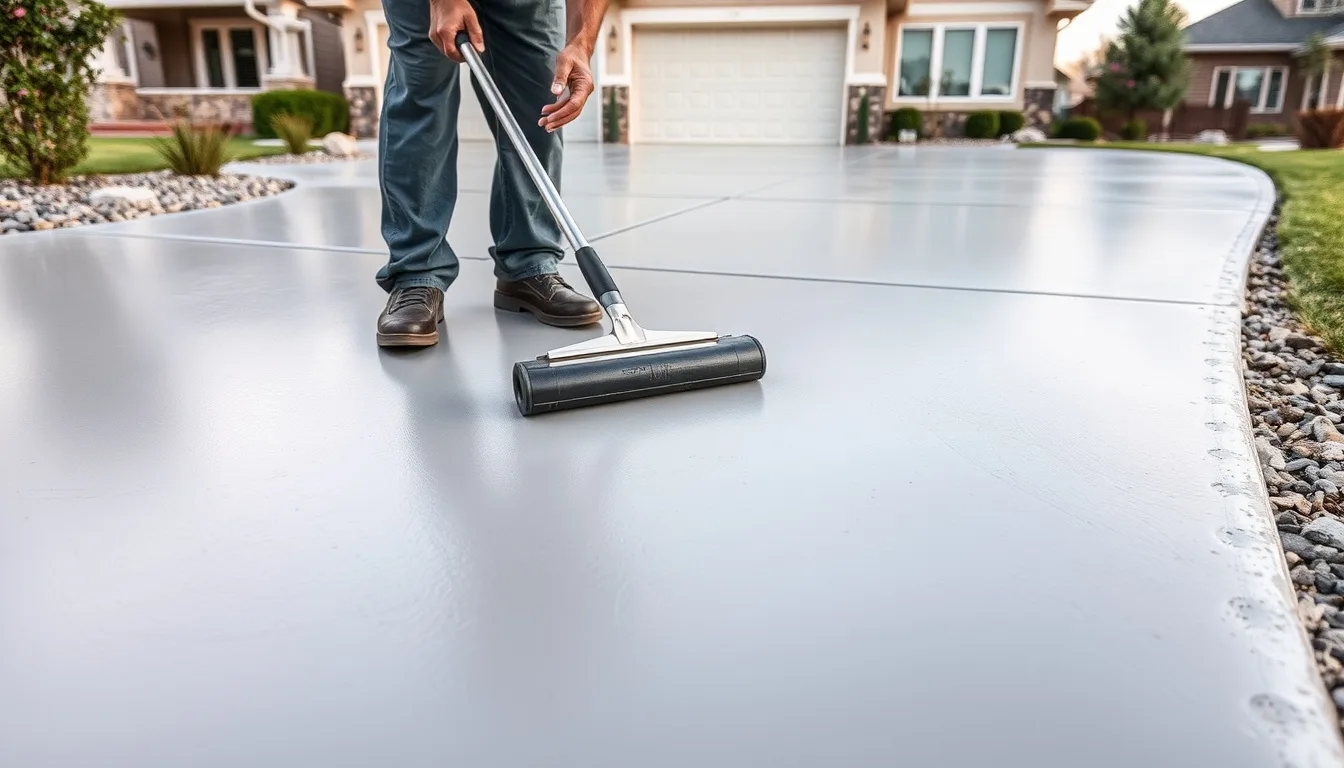
Resurfacing & Overlay — Colorado Springs to Woodland Park
Concrete Resurfacing & Overlay in the Pikes Peak Region — Restore Weathered Concrete Without a Full Tear-Out
Years of elevation freeze-thaw and chloride exposure leave Pikes Peak region concrete pitted and worn even when the slab underneath is still solid. A bonded overlay restores it for a fraction of replacement cost — without erasing the slope your drainage depends on.
When Resurfacing Beats Both Patch Repair and Full Replacement
Resurfacing is the right call when the damage is at the surface — scaling, pitting, minor spalling, or a network of hairline cracks that have already been sealed — and the slab underneath is still structurally sound. If the concrete rings solid when you tap it and isn't broken into multiple separate pieces, it's very likely a resurfacing candidate rather than a replacement job.
Spot patching makes sense for a single isolated area of damage, but once scaling or shallow spalling is spread across most of a driveway, patio, or walkway, patching piece by piece starts to cost more than resurfacing the whole surface at once — and leaves a visibly patchy result. Full replacement, by contrast, is the right call when a slab has settled or heaved unevenly, broken into large separate sections, or has spalling deep enough to have compromised reinforcing steel across a wide area.
Resurfacing also has a real cost advantage: because it keeps the existing slab, foundation prep, and grading in place, it typically costs a fraction of tearing out and repouring the same area. On a graded Pikes Peak region driveway, that matters twice over — keeping the base means keeping the drainage slope engineered into that concrete years ago, instead of gambling on a fresh pour re-establishing it correctly.
How Overlay Prep Works
A resurfacing overlay is only as good as the surface it's bonded to, so prep is most of the job. We start by cleaning and profiling the existing concrete — pressure-washing, then mechanically abrading or acid-etching the surface so the new material has something to grip rather than sitting on top of a slick, worn skin.
Any active cracks or voids in the base slab get addressed before the overlay goes down, not after — an overlay poured over an unsealed active crack will just telegraph that crack straight through the new surface within a season or two. A bonding agent is then applied to lock the new polymer-modified overlay material to the old concrete, and the overlay is screeded, floated, and finished to the chosen texture and — critically on graded surfaces — the existing slope.
Preserving Slope: Why Overlays on Graded Driveways Need Extra Care
Much of the flatwork across Manitou Springs, Cascade, Green Mountain Falls, and the Ute Pass corridor sits on real grade, not the flat pads common on the Front Range plains. An overlay applied without tracking the original slope can inadvertently level out a low spot that was engineered to shed water toward a specific drain or channel, which just relocates the ponding problem instead of fixing the surface.
We survey the existing slope before screeding an overlay on any driveway, patio, or walkway with meaningful grade, and finish the new surface to match it rather than to a flat plane. On terraced properties with retaining walls, we also confirm the overlay ties in cleanly at each transition, since a mismatched edge at a wall or step is where water tends to pool and refreeze first.
Standard vs. Decorative and Stamped Overlay Options
A standard single-color overlay restores a clean, uniform, broom-finished or trowel-finished surface — the most cost-effective option and a strong match for driveways, garage floor extensions, and utility walkways where function matters more than appearance.
Decorative and stamped overlays are a popular upgrade for homeowners replacing worn patios and hillside terraces throughout the region: the overlay can be stamped with a pattern (stone, brick, slate) and colored or stained before sealing, giving an old slab the look of an upscale hardscape material without the cost or disruption of a full tear-out. Both options use the same bonded overlay process underneath — the difference is entirely in the finish work on top.
Sealing for What Elevation Winters Bring
An overlay that isn't sealed is just new concrete waiting to take the same freeze-thaw and chloride damage that wore out the original surface. Sealing the finished overlay closes the pore structure at the surface, meaningfully reducing how much chloride-laden meltwater can penetrate and reducing the freeze-thaw expansion happening inside the material.
This matters more here than at lower elevation. Colorado Springs sits around 6,035 feet; Woodland Park and Divide near 8,400 to 8,900 feet; Cripple Creek close to 9,500 feet — and thinner air combined with intense high-altitude sun drives more freeze-thaw crossings over a winter than the Denver-metro baseline. A properly sealed, air-entrained overlay resists that extra cycling far better than the unprotected original slab ever did, extending the useful life of the repair meaningfully.
Who Resurfacing Is Right For
Resurfacing is the most common right answer for a driveway, patio, or walkway that's taken years of elevation freeze-thaw and chloride exposure and is showing it cosmetically without any structural movement — a slab that still sits flat (or holds its engineered slope) and sounds solid but looks chalky, pitted, or uneven in color.
It's the wrong fit for a slab that's actively heaving or settling from expansive clay movement underneath, or one where drainage on a graded surface is actively undermining the base. Resurfacing over an unstable or poorly draining base just means the same movement telegraphs through the new surface. In those cases we address lifting, leveling, or drainage correction first, then resurface once the slab is holding stable.
What Resurfacing Costs by Finish Level
A basic single-color resurfacing typically runs about $3 to $5 per square foot. Where the existing damage is more extensive — deeper pitting, more crack repair needed before the overlay goes down — cost can run up toward $9 per square foot. Decorative or stamped overlays, which add pattern work, coloring, and additional finishing time, typically run $7 to $20 per square foot depending on the complexity of the finish chosen.
We quote an exact price after inspecting the existing surface and confirming the base slab is a resurfacing candidate rather than a replacement job — square footage alone doesn't determine price, the amount of prep the existing concrete needs, and how much grade the finish crew has to track, both factor in.
Get a Resurfacing Estimate
Send us photos of the damaged surface and your town, or book a free on-site inspection anywhere across the Pikes Peak region. We'll confirm whether resurfacing is the right fit for your slab, walk you through standard versus decorative finish options, and give you a fixed price before any prep work starts.
Request a free estimate through our online form. If your slab also has active cracks, uneven sections, or a drainage issue on a graded surface, we address those as part of the same overlay job rather than sending you to a second crew.
We resurface concrete across Colorado Springs, Manitou Springs, Woodland Park, Cascade, Green Mountain Falls, Fountain, Monument, Palmer Lake, Divide, and Cripple Creek.
Resurfacing & Overlay FAQs
Straight answers before we drill
A basic single-color resurfacing typically runs about $3–$5 per square foot, extensive-damage resurfacing up to roughly $9 per square foot, and decorative stamped or textured overlays about $7–$20 per square foot depending on finish complexity.
It shouldn't, if done correctly. We survey the existing slope before screeding an overlay on graded driveways and finish the new surface to match the original grade rather than to a flat plane, so water keeps draining toward the same low point or channel it always has.
Not usually. Scaling is a surface-level problem, and can typically be resurfaced or overlaid rather than replaced, as long as the base slab underneath is still structurally sound. Full replacement becomes necessary mainly when scaling has progressed to deep spalling with widespread exposed, corroded rebar.
Sealing the overlay before winter, making sure any joints and cracks in the base slab are filled so water can't collect and freeze inside them, and using air-entrained material in the overlay itself all significantly reduce freeze-thaw damage. We build sealing into every resurfacing job for exactly this reason, and it matters more at Pikes Peak region elevations than at the Denver-metro baseline.
Yes — we confirm any overlay ties in cleanly at each retaining wall or step transition on terraced properties, since a mismatched edge is where water tends to pool and refreeze first. We survey the site before quoting to make sure the overlay plan respects the existing terracing rather than fighting it.
Cracked, sunken, or salt-damaged concrete? Get a fixed price before we drill.
Free inspections across the Pikes Peak region. We diagnose high-elevation freeze-thaw, steep-grade drainage, and expansive-soil causes before recommending a repair.