Garage & Interior Slab Repair — Pikes Peak Region
Garage & Interior Slab Repair in the Pikes Peak Region — Fixing the Damage Winter Tracks Inside
Your garage floor takes a full winter of de-icing chloride off every set of tires and boots that cross it. We diagnose the chemistry behind the flaking before we patch it.
A Garage Floor Damages Differently Than an Exterior Slab
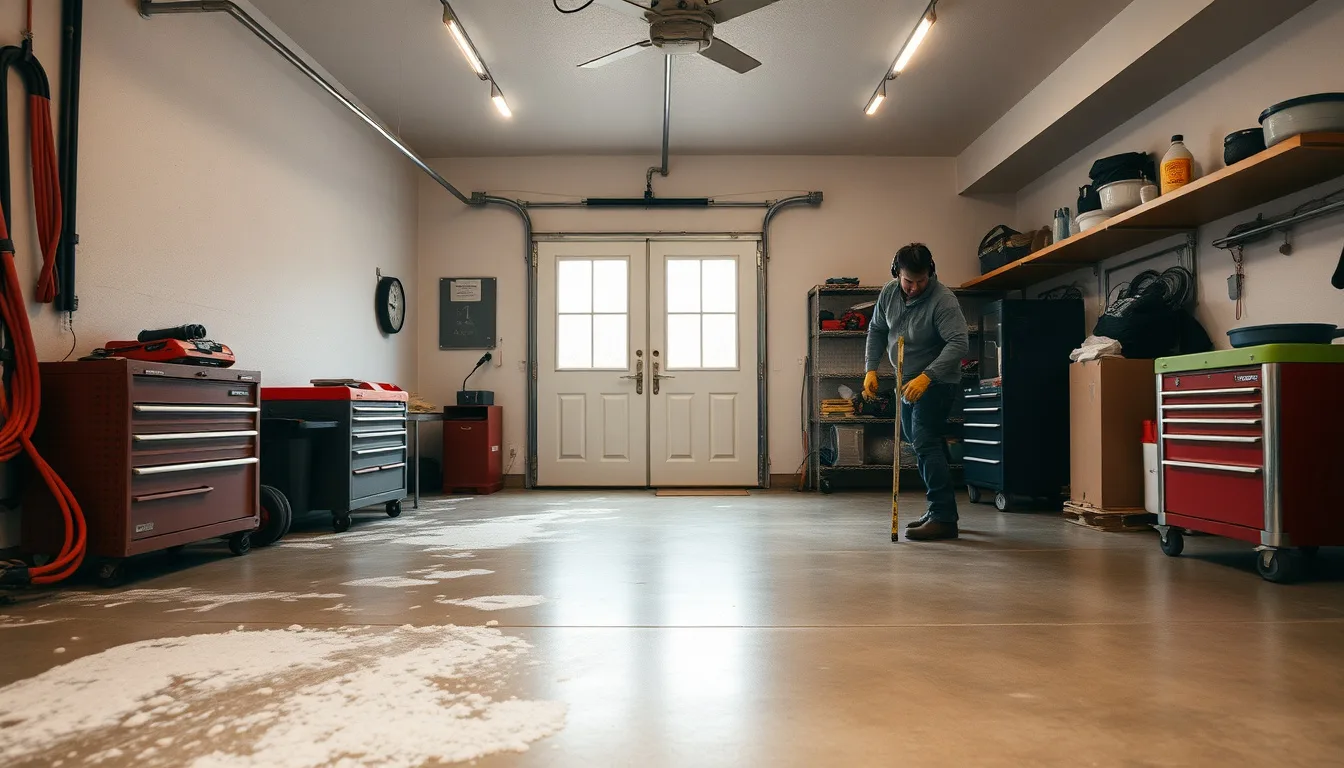
It's easy to assume an interior garage slab is protected from the weather that beats up a driveway or a sidewalk, and in one sense it is — it doesn't sit under open sky taking direct freeze-thaw cycling the way an exterior surface does. But a garage floor across a Pikes Peak region winter takes a different kind of damage: every vehicle that pulls in off a salted road, and every boot that walks in off a treated sidewalk, tracks de-icing chloride directly onto the slab, all winter long, concentrated in a much smaller footprint than an open driveway spreads it over.
That means a garage floor can end up with more chloride exposure per square foot over a season than the driveway outside it, even though it never sees snow directly. The flaking, pitting, and white staining that show up on garage floors by late winter are usually chloride damage, not simple wear.
The Chemistry Behind the Flaking: MgCl2 vs. CaCl2
Colorado municipalities and property owners typically de-ice with one of two chlorides: magnesium chloride (MgCl2) or calcium chloride (CaCl2). MgCl2 is the more common choice because it melts ice at lower temperatures, but it's also measurably more damaging to concrete and up to 10 times more corrosive to mild steel rebar than CaCl2. Whichever product is used on the roads and walks leading to your garage, it comes in on tires and boot soles and dries on the slab surface, cycle after cycle, all winter.
Chloride exposure damages concrete two ways at once. First, it increases the water content held in the concrete's pore structure, which intensifies the expansion stress from any freeze-thaw cycling the slab does experience — garage floors near an open door or a poorly sealed overhead door still see meaningful temperature swings near the entry. Second, chloride ions penetrate down to embedded rebar and steel mesh, corroding the metal; as corroded steel expands, it pushes outward and spalls the concrete around it from the inside, which is why garage floor damage often looks like small craters or flaking patches rather than a clean crack.
The Apron-to-Slab Transition Is Its Own Freeze-Thaw Zone
The section of concrete right at the garage entry — where the exterior driveway apron meets the interior slab — behaves like neither a fully interior surface nor a fully exterior one. It gets direct freeze-thaw cycling like the driveway, plus heavier concentrated chloride exposure than either the open driveway or the interior floor individually, since it's the pinch point every vehicle and every set of boots crosses. At Pikes Peak region elevations, where thin air and intense sun drive faster melt-refreeze swings than the Denver-metro baseline, that entry zone often shows the earliest visible damage on the entire garage slab — cracking, spalling, or a sunken transition where the apron has settled relative to the garage floor.
We inspect that transition zone specifically on every garage visit, because it's frequently the first place that needs repair even when the rest of the interior slab still looks sound.
Expansive Clay Underneath an Attached Garage
Houses across the region are commonly built on drilled piers reaching stable bedrock below the area's Pierre Shale and bentonite-bearing claystone — clay that swells when wet and shrinks when dry, with documented seasonal ground movement of 2 to 6 inches in affected areas. Attached garage slabs, like driveways and patios, usually aren't on those piers, so an attached garage floor can heave, crack, or separate from the house's foundation wall even when the house itself stays perfectly stable. A crack that runs along the wall where the garage meets the house is a common sign of this kind of movement, and it calls for a different repair approach than a chloride-driven surface flaking issue.
Repair Methods for Garage and Interior Slabs
For surface flaking and pitting from chloride exposure, spalling repair is the core fix: a minor surface patch runs $20 to $50 per square foot, while damage that has reached embedded rebar and needs the steel addressed before patching runs $50 to $150 per square foot. A bonded overlay that resurfaces the whole floor in one pass runs $30 to $80 per square foot and gives you a clean, uniform surface rather than a patchwork of repairs.
For cracks — whether from clay movement, slab settlement, or shrinkage — we use caulk sealant on hairline cracks, chiseled filler on mid-width cracks, and epoxy or flexible polyurethane injection on structural cracks depending on whether the crack is still actively moving. One advantage of interior slab work: crack injection and interior floor repair can be done in cold weather with the right materials, unlike exterior resurfacing or new-pour work, which needs temperatures reliably above freezing to cure. That makes garage floor repair one of the few concrete jobs we can schedule through a Pikes Peak region winter without waiting for spring.
Sealing a Garage Floor Against Next Winter's Chloride
Once a garage floor is patched or resurfaced, a penetrating sealer or protective coating meaningfully slows how much chloride gets absorbed into the concrete the following winter, reducing the pace of new pitting and staining. It's a small add-on cost relative to the repair itself, and it's the difference between doing spalling repair once every several years versus every winter cycle. We'll flag whether your floor is a good candidate for sealing as part of the inspection, not as a separate upsell conversation later.
What Garage Slab Repair Costs
Most garage floor jobs land in the spalling and crack repair ranges: $20–$50 per square foot for minor surface patching, $50–$150 per square foot where rebar is exposed, $30–$80 per square foot for a full bonded overlay, and $5–$25-plus per linear foot for crack repair depending on width and method. Severely deteriorated slabs needing full demo and recast run $150–$400-plus per square foot, though that scope is uncommon for interior floors compared to exterior work.
We price on site after inspecting the full floor and the apron transition, since chloride damage patterns vary a lot depending on how the garage is used and how much winter tracking it actually sees.
Get a Free Garage Floor Inspection
Send us photos of the flaking, cracking, or staining and your city, or book a free on-site inspection. We'll tell you plainly whether you're looking at chloride-driven spalling, clay-related cracking, or both, and give you a fixed price before any work starts — including in the middle of winter, since most interior garage work doesn't have to wait for warmer weather.
Request a free estimate through our online form. We repair garage and interior slabs throughout Colorado Springs, Manitou Springs, Woodland Park, Cascade, Green Mountain Falls, Fountain, Monument, Palmer Lake, Divide, and Cripple Creek.
Garage & Interior Slab Repair FAQs
Straight answers before we drill
Vehicles and boots track de-icing chloride in from salted roads and walkways all winter, concentrating it on the garage floor. Magnesium chloride, the most common de-icer regionally, is up to 10 times more corrosive to rebar than calcium chloride, and it also raises the concrete's pore water content, which worsens freeze-thaw expansion damage near entry points.
Yes — crack injection and interior spalling repair can usually be done in cold weather with the right materials, since the slab is sheltered from direct freeze-thaw exposure. That's different from exterior resurfacing or full recast work, which needs temperatures reliably above freezing to cure properly.
The house is likely on drilled piers reaching stable bedrock, but the attached garage slab almost certainly isn't. Expansive clay under the region — swelling when wet, shrinking when dry, with 2–6 inches of documented seasonal movement — can shift the garage slab independently of the house's foundation, opening a crack along that seam.
Yes. A penetrating sealer or protective coating slows how much chloride the concrete absorbs each winter, which meaningfully reduces the pace of new pitting and staining. It's worth doing right after a repair or resurfacing, while the floor is already clean and freshly patched.
Minor surface patching runs $20–$50 per square foot. Where chloride corrosion has reached embedded rebar and the steel needs to be addressed first, cost runs $50–$150 per square foot. A full bonded overlay that resurfaces the entire floor in one pass runs $30–$80 per square foot.
Cracked, sunken, or salt-damaged concrete? Get a fixed price before we drill.
Free inspections across the Pikes Peak region. We diagnose high-elevation freeze-thaw, steep-grade drainage, and expansive-soil causes before recommending a repair.