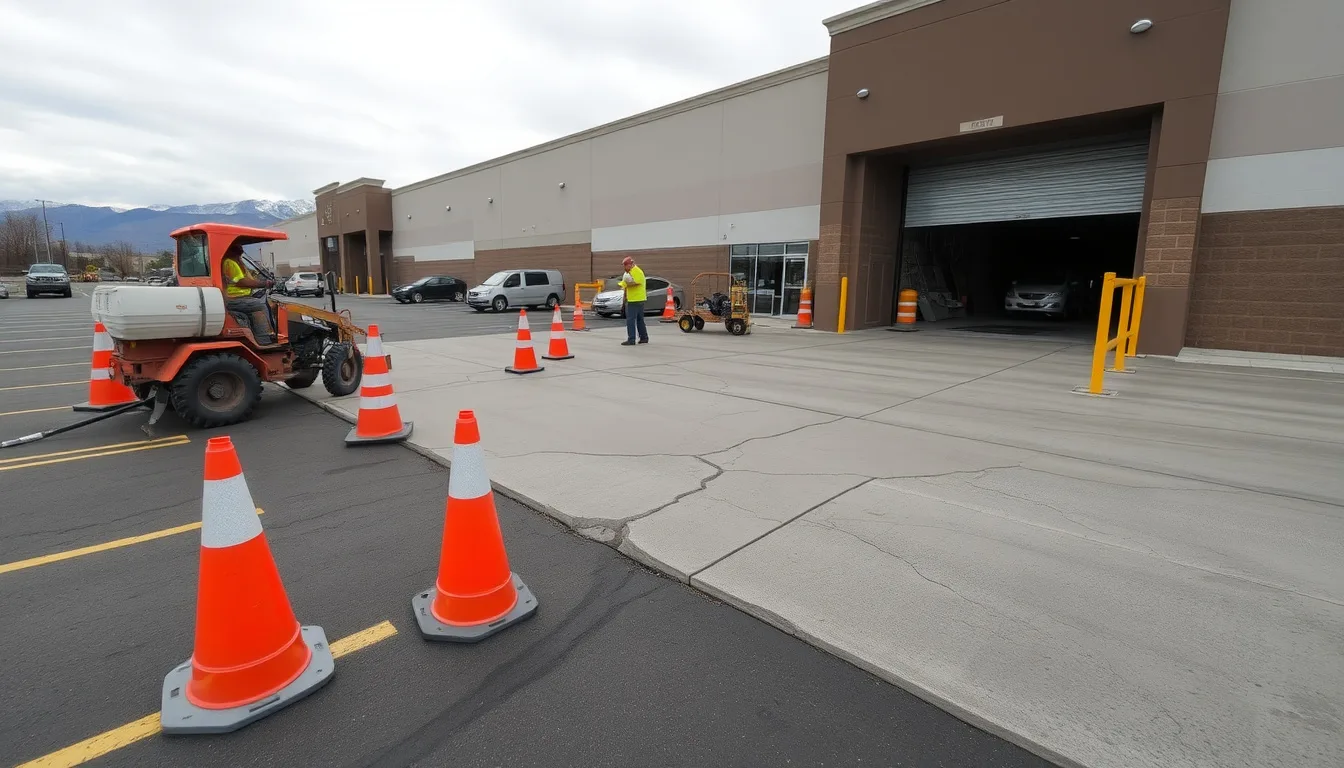
Commercial Concrete Repair — Pikes Peak Region
Commercial Concrete Repair in the Pikes Peak Region — ADA-Aware Repair for Lots, Walks, and Entries
A cracked parking lot or an uneven entry walk is a legal exposure question as much as a maintenance one. We repair to the ADA standard and work around your operating hours.
Commercial Concrete Carries a Different Standard Than Residential
A cracked driveway at home is a homeowner's decision on timeline. A cracked parking lot, entry walk, or loading area at a business is a legal exposure question the moment it crosses the line into a trip hazard — the property owner or tenant is generally responsible for keeping customer- and employee-facing walking surfaces safe and code-compliant, and a documented hazard that goes unaddressed is a liability problem, not just a maintenance one.
That's the lens we use on every commercial site across Colorado Springs, Woodland Park, Monument, and the surrounding towns: identify every surface that fails a safety or accessibility standard, document it clearly, and prioritize the repair order accordingly — trip hazards and ADA violations first, cosmetic wear after.
The ADA 1/4-Inch Rule Is the Baseline for Every Commercial Surface
Under ADA Accessibility Guidelines, any vertical change of 1/4 inch or more between adjacent panels on a walking surface counts as a trip hazard requiring correction — full stop, regardless of how the rest of the lot or walkway looks. On a commercial property this applies to parking lot pedestrian paths, sidewalk frontage, accessible parking space approaches, and entry aprons alike. We walk every commercial site with that exact threshold in hand, measuring and photographing every panel offset so you have a clear, documented record of what needs correction and why — useful both for prioritizing repair budget and for demonstrating that identified hazards were addressed promptly.
Ramps, accessible parking space slopes, and curb cuts get particular attention, since those elements carry additional ADA slope and clearance requirements beyond the flat 1/4-inch rule that apply anywhere pedestrians cross from a parking surface to a building entrance.
Elevation Freeze-Thaw and Heavy Salt Application Compound Across a Large Lot
Commercial lots and sidewalks typically get the heaviest de-icing salt application of any surface type, since keeping a customer-facing lot and entry ice-free is treated as an operational priority through every storm of the season. That heavy, repeated chloride exposure — commonly magnesium chloride, which is up to 10 times more corrosive to embedded rebar than calcium chloride — works across a much larger surface area on a commercial property than a residential driveway ever sees, which means the cumulative damage adds up faster.
Layer elevation on top of that. The Pikes Peak region sees more freeze-thaw crossings per winter than the roughly 149-cycle Denver-metro baseline, since thinner air at elevation changes temperature faster and intense high-altitude sun thaws ice on a lot surface even when the surrounding air stays below freezing. A large commercial lot has more total joint length, more panel edges, and more square footage exposed to that combined chloride-and-freeze-thaw stress than almost any residential surface, which is why commercial concrete often needs a proactive repair schedule rather than a reactive one.
Steep-Grade Drainage on Hillside Commercial Developments
Business districts built into foothill and mountain-corridor terrain — parts of Woodland Park, Monument, and Manitou Springs among them — often sit on real grade rather than flat pads, and that changes how a commercial lot fails. Water sheets off the steep sections of a graded lot quickly but concentrates at low points, drive aisle transitions, and single drainage channels, so cracking and joint failure on a sloped commercial lot cluster at predictable spots rather than spreading evenly across the pavement.
When we level or repair sections of a graded commercial lot, we preserve the lot's engineered slope rather than just flattening the repaired area, since commercial lots are typically graded intentionally to move stormwater to a specific catch basin or drainage easement — flattening a repaired section without accounting for that can redirect water somewhere it isn't supposed to go.
Repair Scope: From a Single Cracked Panel to a Full Lot Section
Commercial repair covers the same range of methods as residential work, scaled to commercial square footage: crack injection ($5–$25-plus per linear foot depending on width and whether epoxy or flexible polyurethane is the right material), spalling and scaling repair where rebar corrosion has set in ($20–$150 per square foot depending on severity), resurfacing or a decorative overlay for entry areas and walkways ($3–$20 per square foot), and lifting or leveling settled panels with mudjacking or polyurethane foam ($3–$25 per square foot depending on method and void volume).
For large parking lot sections, mudjacking is frequently the more cost-effective choice given the square footage involved, while foam gets reserved for smaller, precision sections like entry aprons and accessible parking approaches where minimizing closure time matters more than cost per square foot.
Scheduling Repair Without Shutting Down the Business
Commercial work gets scheduled around your operating hours, not the other way around. Sectional repair — closing off one drive aisle, one entry walk, or one parking row at a time rather than the whole lot — keeps the rest of the property usable while work is underway, and off-hours or overnight scheduling is available for repairs that need a full closure, like a larger resurfacing pass or a section requiring the 1-to-3-day mudjacking cure window.
We plan the sequencing with you before work starts: which sections close, in what order, and for how long, so there are no surprises for staff or customers mid-repair.
What Commercial Concrete Repair Costs
Because commercial jobs scale with square footage and often involve multiple repair types on one site, most commercial estimates are itemized by section rather than a single blanket number: crack repair per linear foot, spalling or resurfacing per square foot by area, and lifting/leveling per square foot by section. As a general range, minor spalling patches run $20–$50 per square foot, rebar-involved spalling runs $50–$150 per square foot, resurfacing runs $3–$20 per square foot depending on finish, and full demo-and-recast for badly failed sections runs $150–$400-plus per square foot.
We walk the full site, measure every ADA-relevant offset, and provide an itemized, fixed-price scope before any work starts — so budget approval and scheduling can happen with real numbers, not a rough phone estimate.
Get a Free Commercial Site Inspection
Send us photos of the lot, walkway, or entry area along with your business address, or book a free on-site inspection. We'll walk the full property, flag every ADA-relevant trip hazard, and give you an itemized, fixed-price repair plan sequenced around your operating hours.
Request a free estimate through our online form. We handle commercial concrete repair throughout Colorado Springs, Manitou Springs, Woodland Park, Cascade, Green Mountain Falls, Fountain, Monument, Palmer Lake, Divide, and Cripple Creek.
Commercial Concrete Repair FAQs
Straight answers before we drill
The property owner or the tenant responsible for the site under their lease is generally responsible for keeping customer- and employee-facing walking and parking surfaces safe and code-compliant. Any panel offset of 1/4 inch or more is a documented ADA trip hazard that should be corrected promptly rather than left for a future maintenance cycle.
Yes. Most commercial jobs are done in sections — one drive aisle, entry walk, or parking row at a time — so the rest of the property stays open and usable. Off-hours or overnight scheduling is available for repairs that need a full closure, such as larger resurfacing passes or sections requiring a multi-day cure.
Commercial lots and sidewalks typically get the heaviest de-icing salt application of any surface type, and they cover far more total square footage and joint length than a residential driveway. That heavier chloride exposure, combined with the Pikes Peak region's above-baseline freeze-thaw cycling, adds up to more cumulative damage across the property over time.
The core rule is that any vertical change of 1/4 inch or more between adjacent panels on a walking surface counts as a trip hazard requiring correction. Accessible parking approaches, curb cuts, and ramps carry additional slope and clearance requirements beyond that flat threshold, and those get specific attention during a commercial inspection.
Commercial estimates are itemized by section and repair type rather than a single blanket price, since a site often needs a mix of crack repair, spalling repair, resurfacing, and lifting or leveling. We walk the full property, measure every relevant section, and provide a fixed, itemized price before work starts.
Cracked, sunken, or salt-damaged concrete? Get a fixed price before we drill.
Free inspections across the Pikes Peak region. We diagnose high-elevation freeze-thaw, steep-grade drainage, and expansive-soil causes before recommending a repair.