Concrete Repair Cost in the Pikes Peak Region: 2026 Guide to Crack Repair, Resurfacing, Spalling & Lifting Prices
Homeowners from Colorado Springs up to Cripple Creek asking "how much does concrete repair cost" are usually asking three things at once: what's actually wrong with the slab, what it costs to fix, and whether it's going to hold up given everything this region's terrain and climate throw at concrete. The honest answer starts with the damage, not the square footage — a hairline crack from ordinary shrinkage and a structural crack driven by clay soil movement or a graded slab's drainage pattern cost very different amounts to fix correctly, even on slabs of the same size.
This guide lays out real 2026 numbers for crack repair, spalling and scaling repair, resurfacing, and lifting/leveling across the Pikes Peak region, along with a straight answer to a question we get constantly: does being at higher elevation, or on a steep lot, change the price? Read the quick-answer table first, then use the deep-dive sections to match your damage to the right repair.
Quick-Answer Cost Table
- Crack repair/injection: $5–$8 per linear foot for hairline caulk, $8–$15 per linear foot for chiseled structural filler, $15–$25+ per linear foot for epoxy or flexible injection on wider structural cracks — a typical single job runs about $250–$500
- Resurfacing/overlay: $3–$5 per square foot for basic single-color resurfacing, up to about $9 per square foot for extensive-damage prep, $7–$20 per square foot for decorative stamped or textured overlays
- Spalling repair: roughly $20–$50 per square foot for a minor surface patch, $50–$150 per square foot once rebar cleaning or replacement is involved, $30–$80 per square foot for a bonded overlay, and $150–$400+ per square foot for full demolition and recast on severe spalling
- Mudjacking: typically $3–$6 per square foot, cures in 1–3 days, and commonly needs redoing within 5–10 years
- Polyurethane foam lifting: typically $5–$25 per square foot, cures to walkable strength in about 15 minutes, and holds up considerably longer on active ground
- Full replacement: usually several times the cost of repairing the same slab once demolition, haul-off, forming, and cure time are counted
Every one of those ranges is honest, and every one is incomplete without knowing the cause. A cosmetic hairline crack costs almost nothing to seal. A structural crack driven by clay movement under a terraced Manitou Springs patio needs a different repair plan — and a different price — even if it measures the same number of linear feet.
Does Elevation or Grade Change the Price? A Straight Answer
This is worth addressing head-on because it's the question that makes this region's pricing different from a generic cost guide. The short answer: elevation and steep grade generally do not change the per-square-foot or per-linear-foot price of a repair. A linear foot of epoxy crack injection costs about the same whether it's poured in Fountain at 5,538 feet or Cripple Creek at 9,494 feet — the material, labor, and equipment cost the same either way.
What elevation and grade do change is diagnosis time and scope, and that shows up in the total project cost, not the unit price:
- Diagnosis takes longer on graded, terraced lots. Tracing where water is actually concentrating on a sloped driveway, or which terrace of a hillside patio is moving independently of the others, is real inspection work that a flat Denver-style slab simply doesn't require. That's time, and it's built into a fair estimate — but it's billed as inspection and diagnosis, not as a markup on the per-foot repair price.
- Access can add setup time on steep lots. A driveway that climbs a full story, or a patio reached by a narrow terraced path, can take longer to get equipment and material to than a flat, street-level slab. That's a real cost, but it's an access-and-logistics line, not a change to the base repair rate.
- Scope is often larger on graded and higher-elevation properties, not because the price per foot went up, but because there's more damage to address. A driveway in Woodland Park that's been through more freeze-thaw cycles than a comparable driveway in Fountain may simply have more linear feet of cracking or more square footage of scaling to repair — the unit price didn't change, but the bill is bigger because there's more work.
So if you're comparing a quote for repair work in Divide against a generic online estimate written for a flat Denver subdivision, don't expect the per-foot numbers to look different. Expect the total to reflect a more thorough inspection and, in many cases, a larger scope of actual damage.
Crack Repair Deep Dive
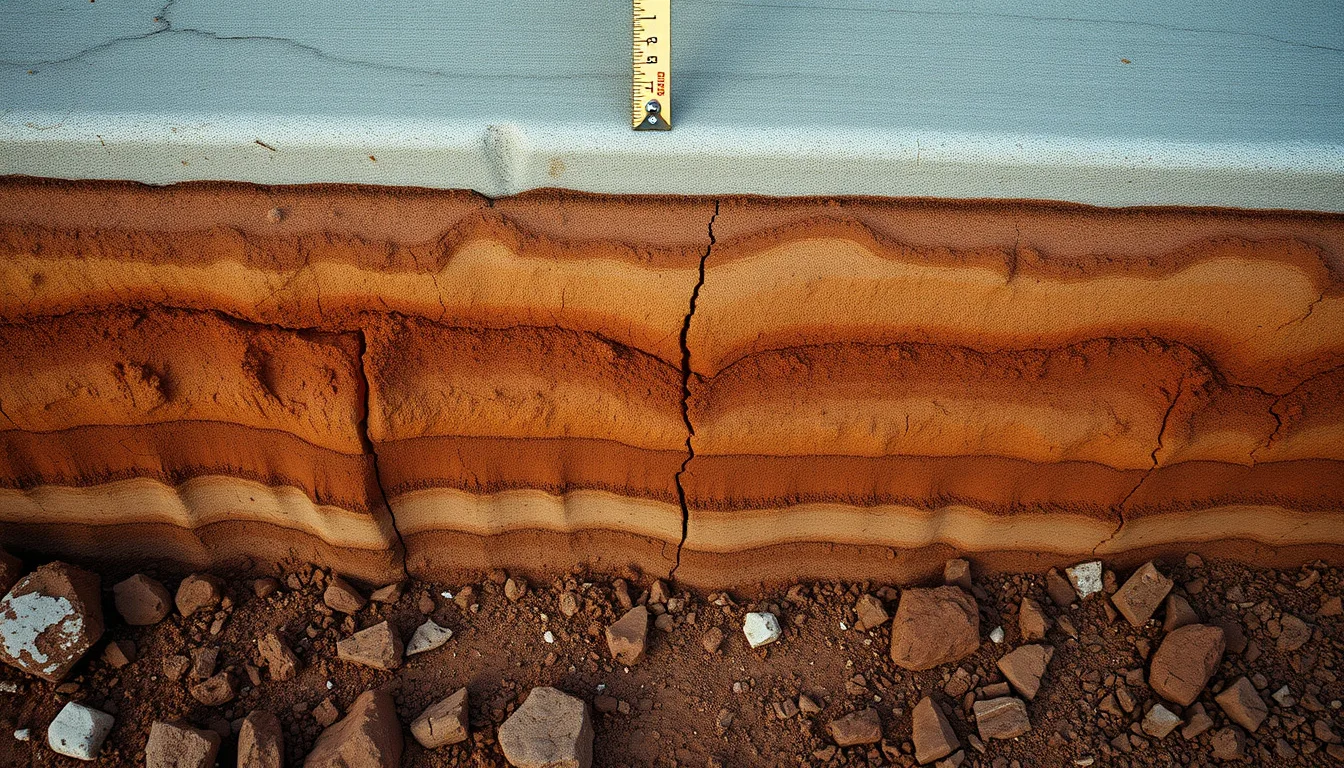
Cracks in this region widen for a mix of reasons covered in more depth in our companion guides: freeze-thaw cycling that's often more frequent at higher elevation, expansive clay soil movement running roughly 2 to 6 inches seasonally in affected areas, and — on graded lots — water concentrating at predictable low points instead of spreading out evenly.
Three repair methods cover almost every crack in the region:
- Hairline caulk/sealant — for cosmetic cracks under about 1/8 inch that aren't moving; runs roughly $5–$8 per linear foot
- Chiseled structural filler — for cracks in the 1/4–1/2 inch range; runs about $8–$15 per linear foot
- Epoxy or flexible injection — for wider structural cracks; runs $15–$25+ per linear foot, with a typical single job landing around $250–$500
The material choice matters more here than the price does: a rigid epoxy fill is right for a static crack, but a crack that's actively moving because it sits over expansive clay or a shifting terrace needs a flexible polyurethane sealant instead, or it can simply crack again right next to the repair. Getting that diagnosis right — static versus actively moving — is the single biggest factor in whether a crack repair holds for years or fails again by next spring, and it's exactly the kind of judgment call that takes longer to make correctly on a hillside lot than on a flat one.
Spalling & Scaling Repair Deep Dive
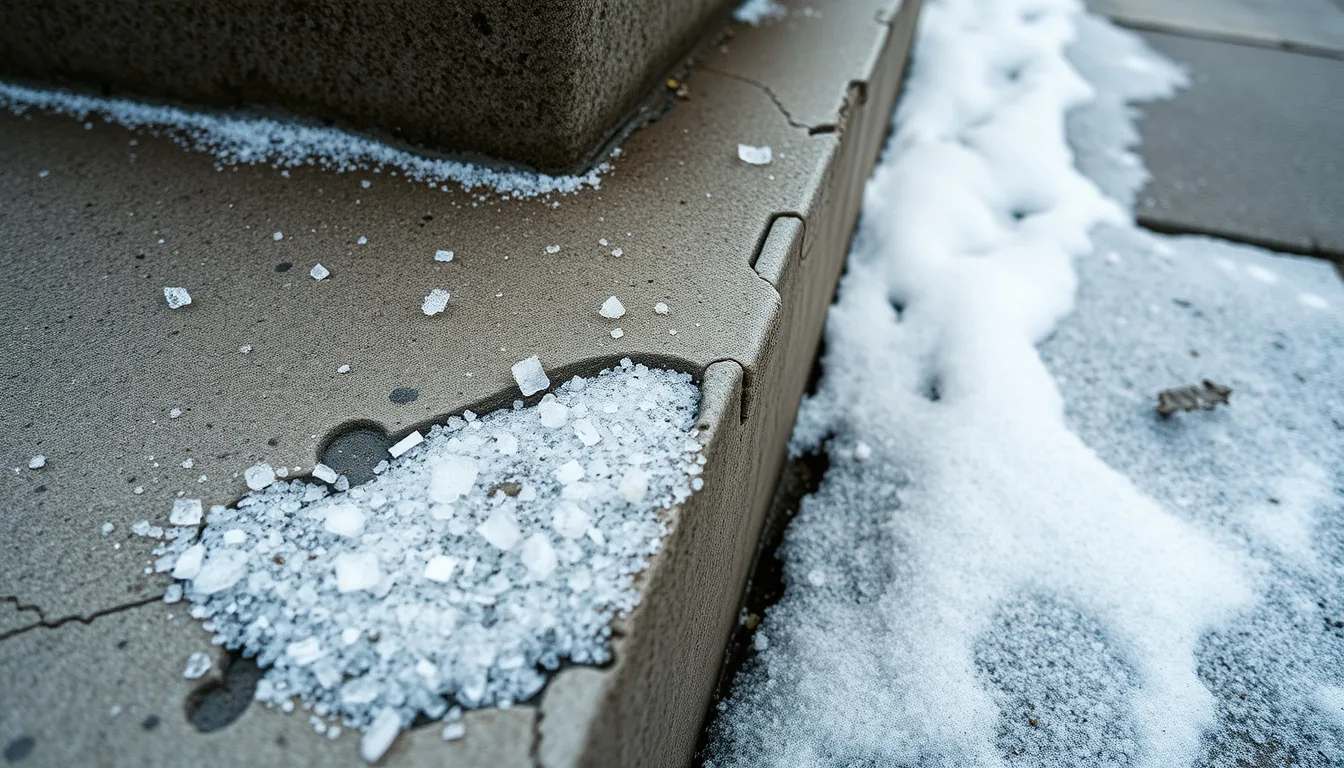
Scaling and spalling are stages of the same damage story, and in this region that story is usually driven by de-icing salt chemistry compounding freeze-thaw cycling. Magnesium chloride causes considerably more scaling and rebar corrosion than calcium chloride, and steep, high-elevation driveways in this region often see heavier de-icing product use per season than flat, lower-elevation roads and driveways — more on that in our de-icing salt guide.
Repair pricing tracks how far the damage has progressed:
- Minor surface patch for scaling that hasn't reached rebar: roughly $20–$50 per square foot
- Patch with rebar cleaning or replacement once corrosion is exposed: roughly $50–$150 per square foot
- Bonded overlay to restore a full damaged surface: roughly $30–$80 per square foot
- Full demolition and recast for severe, widespread spalling: $150–$400+ per square foot
The honest takeaway is the same here as anywhere: scaling caught early is one of the cheapest fixes on this whole page. Left alone for several winters of heavy de-icing exposure and freeze-thaw cycling, it becomes one of the most expensive.
Resurfacing & Overlay Deep Dive
Resurfacing is the right call when damage is surface-level and the slab underneath is still structurally sound — often the natural next step after crack injection or minor spalling repair on a driveway or patio that's taken years of freeze-thaw and salt exposure and just needs a uniform, sealed surface back.
Basic single-color resurfacing typically runs $3–$5 per square foot, climbing toward $9 per square foot when extensive surface prep is needed first. Decorative and stamped overlays run $7–$20 per square foot depending on pattern and finish complexity.
On a graded slab, resurfacing has one extra consideration flat lots don't: the new surface has to preserve the original slope for drainage to keep working correctly, not flatten it out for the sake of a uniform-looking pour. That's a diagnosis-and-planning step, not a price change — but it's one more reason resurfacing quotes on sloped Pikes Peak region flatwork should come from an on-site look, not a phone guess.
Lifting & Leveling Deep Dive: Mudjacking vs. Polyurethane Foam
Uneven concrete in this region comes from expansive clay swelling and shrinking seasonally, sometimes compounded by frost heave. On graded and terraced lots, lifting has an added requirement: the repair has to restore the slab's original intended slope, not just bring it back to level, or it can send water toward a garage, a foundation, or a neighboring terrace that wasn't a problem before.
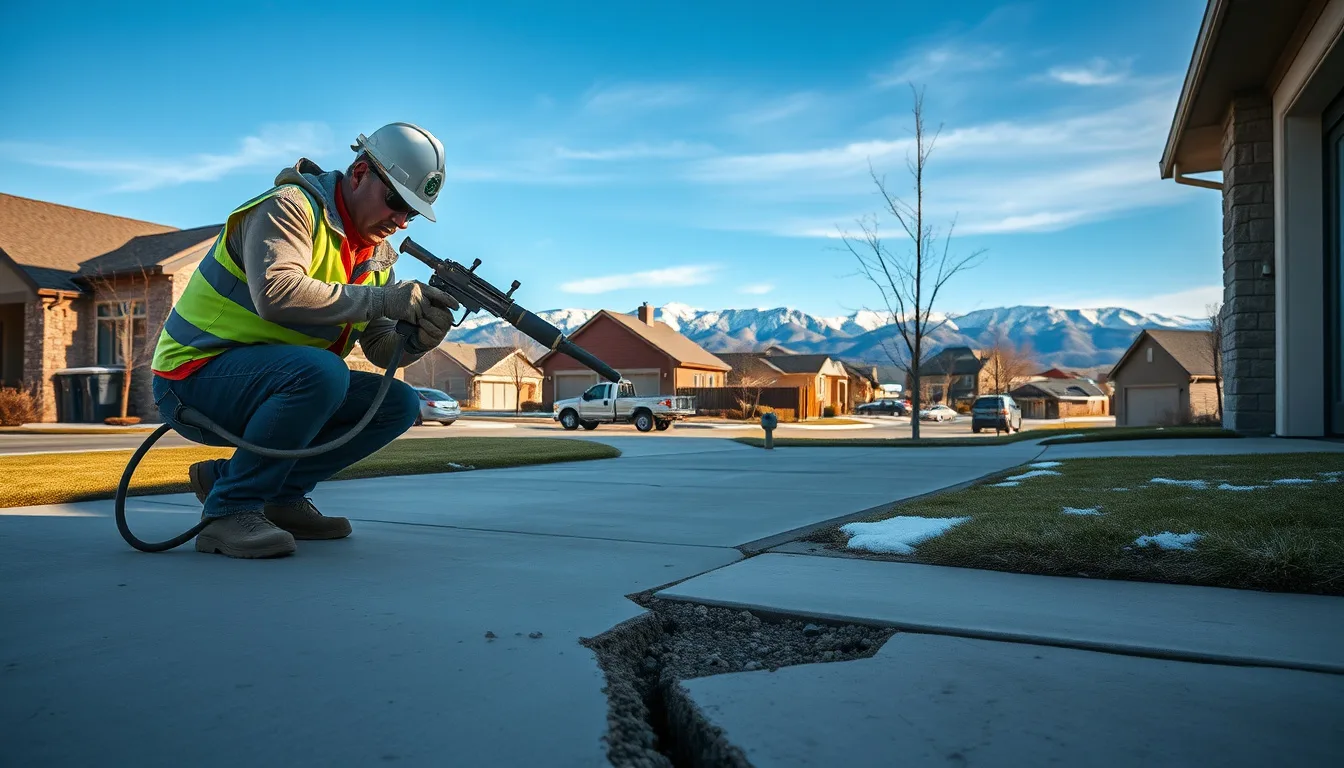
- Mudjacking pumps a heavier cement-and-soil slurry through 1–2 inch holes and needs roughly 1–3 days to cure; it typically runs $3–$6 per square foot and commonly needs redoing within 5–10 years
- Polyurethane foam injection uses expanding lightweight foam through dime-sized holes, reaches usable strength in around 15 minutes, and typically runs $5–$25 per square foot
Weight is the deciding factor on this region's active clay: mudjacking slurry runs over 100 pounds per cubic foot, while cured polyurethane foam weighs roughly 2 pounds per cubic foot. Loading a hundred-plus pounds per cubic foot on top of ground that's already actively swelling and shrinking adds real weight to soil that's already moving; foam lifts the slab without reloading the clay underneath it. On the steepest, most active hillside lots, that difference matters even more, because a foam lift can typically be precisely dosed to restore a specific grade without the added weight complicating things further.
One honest caveat belongs in every estimate here: on the most active expansive-soil sites, either method may need a follow-up re-level after a severe wet-to-dry swing, because the clay itself keeps cycling. A fair contractor tells you upfront if your property looks like one of those cases.
Cost by Project Type
- Driveway: takes freeze-thaw, de-icing salt exposure, and clay movement all at once, and on graded lots adds drainage-driven damage concentrated at low points — often the single most expensive flatwork repair on a property
- Patio: frequently sits on backfill against a foundation or retaining wall, exactly where clay swelling and wall drainage pressure concentrate, sometimes tilting the slab and reversing drainage as part of the damage
- Sidewalk/walkway section: typically the smallest individual repair, but heavy de-icing application per square foot means scaling recurs here often
- Retaining wall-adjacent flatwork: priced case by case, since wall drainage and soil pressure usually need inspection alongside the visible concrete damage
- Steps and terrace landings: common on hillside lots in Manitou Springs, Woodland Park, and Cascade; priced by scope since each landing can be moving independently of the others
- Garage floor: an interior slab that still takes real damage, since de-icing salt and moisture ride in on every vehicle's tires all winter
Repair vs. Replace, and How to Vet a Contractor
Repair is almost always the better value. Crack injection, resurfacing, and lifting typically cost a fraction of full tear-out and replacement, and preserve an existing finish a fresh pour can't reproduce. Replacement earns its keep mainly when a slab is broken into multiple large pieces, has severe spalling with widespread corroded rebar exposed throughout, or has heaved and settled so unevenly that leveling can't restore a usable surface or the original grade.
Whoever you hire, hold them to a short checklist:
- A real on-site inspection before a firm price — not a phone-quote guess, especially on a graded or terraced lot
- A stated cause, not just a repair method — freeze-thaw, de-icing salt, expansive clay, drainage on grade, or a combination, explained plainly
- Written terms on what happens if a lift needs a follow-up re-level on active clay
- Drainage addressed alongside the concrete fix, particularly on sloped lots where one channel or low point is doing most of the damage
- An honest no — a contractor who's never told a customer replacement was the better call is selling, not diagnosing
Frequently Asked Questions
How much does concrete repair cost in the Pikes Peak region?
Most projects run from a few hundred dollars for a single crack or patch up to several thousand for resurfacing or lifting a full driveway or patio. Cost depends on the damage type — crack, scaling, spalling, or unevenness — the repair method, and square footage. A fixed price should come after an on-site inspection, not a phone-quote guess.
Does living at higher elevation like Woodland Park or Divide make repairs more expensive than in Colorado Springs?
Not on a per-square-foot or per-linear-foot basis — those unit prices are the same regardless of elevation. What can make the total bill larger is scope: higher-elevation towns tend to see more freeze-thaw cycling over a winter, which can mean more linear feet of cracking or more square footage of scaling to address, not a higher rate for the same repair.
Does a steep driveway cost more to repair than a flat one?
The repair method's unit price doesn't change, but diagnosis and access can add time and cost. Tracing where water concentrates on a graded driveway, and making sure a lift or resurfacing preserves the original slope, takes real inspection work that a flat slab doesn't require — that shows up as a more thorough estimate, not a markup on the per-foot number.
What's the difference between mudjacking and polyurethane foam lifting, cost-wise?
Mudjacking is typically the lower up-front cost per square foot, while polyurethane foam costs more per square foot but usually lasts considerably longer, especially on this region's active clay soil, and can be precisely dosed to preserve a slab's intended grade on sloped lots. We quote both from an on-site inspection so you can compare total cost over time, not just the initial number.
Is repair cheaper than full concrete replacement?
Almost always. Crack injection, resurfacing, and lifting typically cost a fraction of full tear-out and replacement, and they let you keep an existing finish that a fresh pour can't match. A trustworthy contractor tells you honestly when a slab is too far gone and replacement is the better value.
Do you offer free estimates and inspections across the whole Pikes Peak region?
Yes, inspections and quotes are free across Colorado Springs, Manitou Springs, Woodland Park, Cascade, Green Mountain Falls, Fountain, Monument, Palmer Lake, Divide, and Cripple Creek. We assess the actual cause of the damage — freeze-thaw, de-icing salt, expansive clay, drainage on grade, or a combination — before recommending a fixed-price repair, rather than quoting blind over the phone.
Get a Fixed Price Built Around Your Actual Property
Every driveway, patio, walk, and set of steps in the Pikes Peak region is dealing with some combination of elevation-driven freeze-thaw, de-icing salt exposure, expansive clay movement, and — on so many of these lots — real grade and drainage concentration that flat Denver-metro flatwork never has to handle. We inspect for free across the full region and hand you a fixed price after we've actually looked at the damage and the terrain it's sitting on. Request a free on-site estimate through our online form, and get a repair plan that fits your elevation, your slope, and your actual damage — not a generic number.
Ready for a real number?
Free inspections across the Pikes Peak region — measured on site, fixed price before any drilling starts.